
Electroporation Products
* This product is for research use only. Not intended for use in the treatment or diagnosis of disease.
| Catalog | Product Name | Inquiry |
|---|---|---|
| BT-000076 | RBL-2H3 Cells Electroporation Kit | Inquiry |
| BT-000075 | Ramos Cells Electroporation Kit | Inquiry |
| BT-000074 | Raji Cells Electroporation Kit | Inquiry |
| BT-000073 | Daudi Cells Electroporation Kit | Inquiry |
| BT-000072 | CCRF-CEM Cells Electroporation Kit | Inquiry |
| BT-000037 | TIB-152 Electroporation Kit | Inquiry |
| BT-000036 | TIB-71 Electroporation Kit | Inquiry |
| BT-000035 | CCL-246 Electroporation Kit | Inquiry |
| BT-000034 | CCL-243 Electroporation Kit | Inquiry |
| BT-000033 | CCL-240 Electroporation Kit | Inquiry |
| BT-000032 | CCL-119 Electroporation Kit | Inquiry |
| BT-000031 | Genaral Electroporation kit | Inquiry |
Electroporation, as an increasingly popular physical transfection method, uses high voltage to introduce exogenous nucleic acids into many types of cells (including bacteria and mammalian cells). BOC Sciences has successfully developed a variety of electroporation reagents to promote their application in different types of cell lines.
Our Electroporation Products include:
- Broad spectrum electroporation reagents
- Cell specific electroporation reagents
Advantages of our electroporation products
- High-efficiency
- Compatible with most conventional electroporation devices
- Save money and reduce research costs
- Certified RNAse and DNAse-free electroporation buffer
- High cell viability
- Reproducibility
- Electroporation protocol is included when purchasing an electroporation transfection kit
High-efficiency and stable transformation and transient gene expression
BOC Sciences's electroporation transfection kits can be used as a standalone solution or as part of a complete kit with test tubes and cell droppers
A high percentage of cells are transfected without compromising their viability
Effective electroporation delivery and high cell viability provide reproducible electroporation results
Electroporation workflow
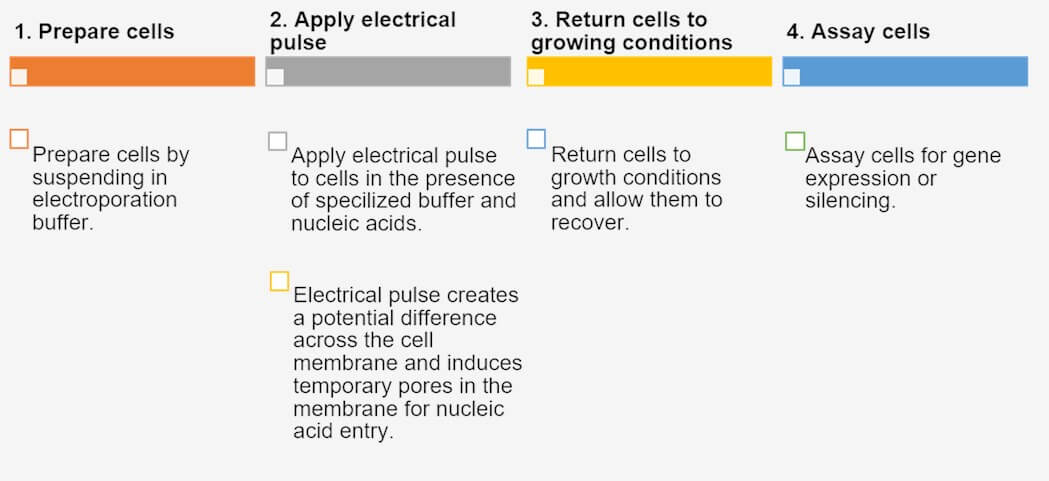 Figure 1: Electroporation workflow.
Mechanism and application of electroporation
When the cell receives a controllable electrical pulse, the phospholipid layer opens to form a temporary physical channel, allowing nucleic acids and other substances to enter the cell. Under the right conditions, the channel will quickly close, returning the cell to its original state. This is an efficient strategy for introducing foreign nucleic acids.
In addition to direct gene introduction, electroporation also facilitates the direct transfer of plasmids between cells or species, for example, from bacteria to yeast. Moreover, in disease treatment research, many scientists are using electroporation to deliver drugs and vaccines directly to cells of living organisms for disease treatment/immunity research.
We guarantee that all products undergo strict quality control to ensure the best performance. If you want to know more about our transfection ability, don’t hesitate to contact us.